
The CEO Of OthersideAI Wrote A Terrifying Article About The Future Of AI (Basically We're All Doomed And It's Going To Happen Within A Year)
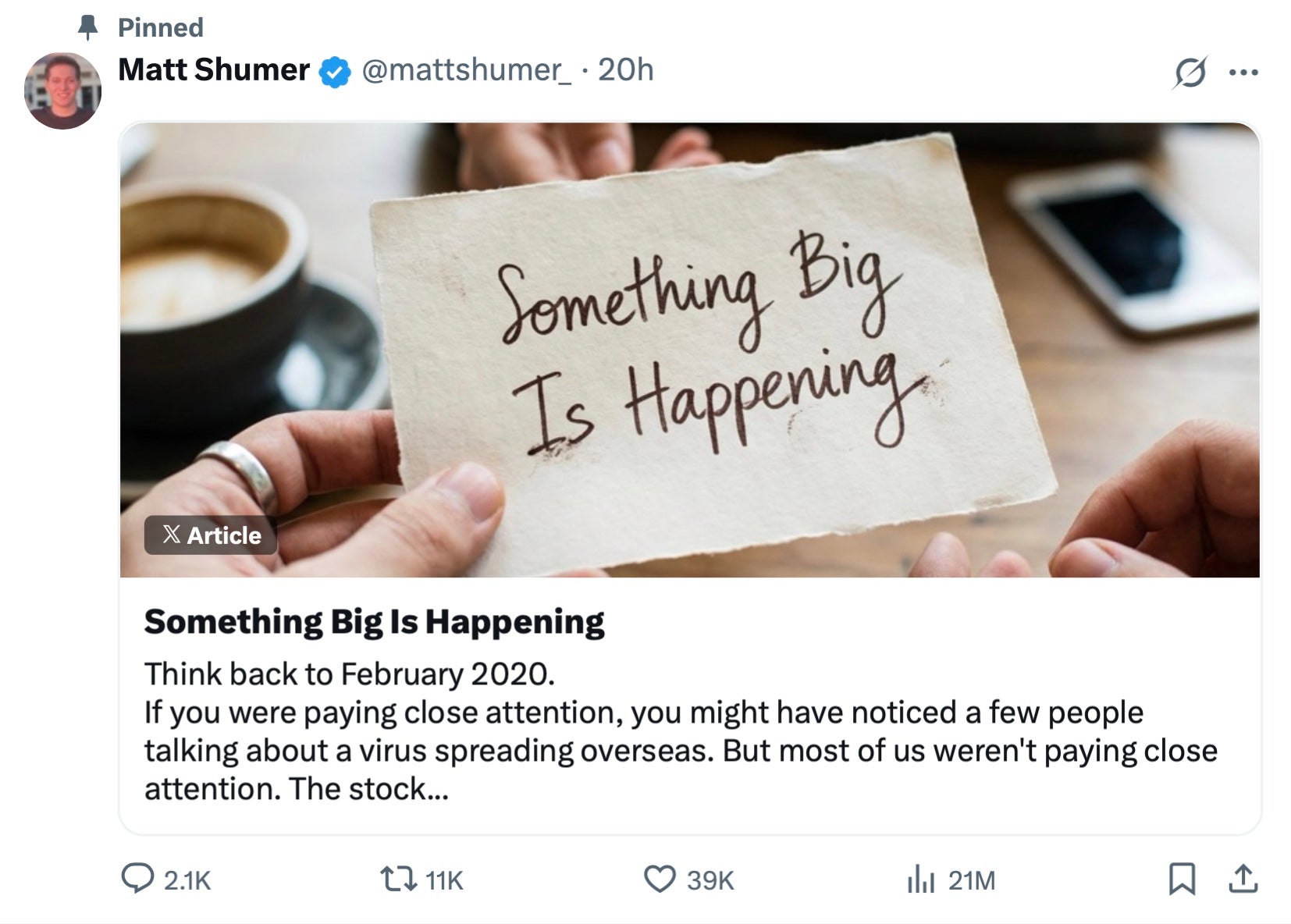
It's a long article. I found it to be a pretty horrifying article to read first thing in the morning. But I'd be lying if I said it didn't have me hooked by the end of the first paragraph. And I'm going to go out limb and say this Matt Shumer guy, CEO of OthersideAI, used AI to help with a majority of it. So I guess today's AI can produce captivating writing too. Awesome.
To briefly sum up his article, Matt Shumer says AI is improving almost exponentially. That in his industry, AI has made strides in the last month that make it nearly unrecognizable to what it was just a few months ago. Judging AI based off the free versions most people use is like judging modern cell phone technology using an old Nokia flip phone. AI has reached point where it is now able to improve on itself without human direction.
There's an organization called METR that actually measures this with data. They track the length of real-world tasks (measured by how long they take a human expert) that a model can complete successfully end-to-end without human help. About a year ago, the answer was roughly ten minutes. Then it was an hour. Then several hours. The most recent measurement (Claude Opus 4.5, from November) showed the AI completing tasks that take a human expert nearly five hours. And that number is doubling approximately every seven months, with recent data suggesting it may be accelerating to as fast as every four months.
Shumer says that in his industry, AI has gone from a helpful tool, to being able to completely do the technical aspect of his job.
I am no longer needed for the actual technical work of my job. I describe what I want built, in plain English, and it just… appears. Not a rough draft I need to fix. The finished thing. I tell the AI what I want, walk away from my computer for four hours, and come back to find the work done. Done well, done better than I would have done it myself, with no corrections needed. A couple of months ago, I was going back and forth with the AI, guiding it, making edits. Now I just describe the outcome and leave.
Let me give you an example so you can understand what this actually looks like in practice. I'll tell the AI: "I want to build this app. Here's what it should do, here's roughly what it should look like. Figure out the user flow, the design, all of it." And it does. It writes tens of thousands of lines of code. Then, and this is the part that would have been unthinkable a year ago, it opens the app itself. It clicks through the buttons. It tests the features. It uses the app the way a person would. If it doesn't like how something looks or feels, it goes back and changes it, on its own. It iterates, like a developer would, fixing and refining until it's satisfied. Only once it has decided the app meets its own standards does it come back to me and say: "It's ready for you to test." And when I test it, it's usually perfect.
Developers focused on making AI great at coding first, because AI requires writing a lot of code. But it's only a matter of time before it's able to do your job as well. No job done on a computer is safe, and it could be months, not years, before you are affected. Experts believe that within 5 years, AI will have replaced 50% of entry-level white collar jobs.
Dario Amodei, who is probably the most safety-focused CEO in the AI industry, has publicly predicted that AI will eliminate 50% of entry-level white-collar jobs within one to five years. And many people in the industry think he's being conservative. Given what the latest models can do, the capability for massive disruption could be here by the end of this year. It'll take some time to ripple through the economy, but the underlying ability is arriving now.
This is different from every previous wave of automation, and I need you to understand why. AI isn't replacing one specific skill. It's a general substitute for cognitive work. It gets better at everything simultaneously. When factories automated, a displaced worker could retrain as an office worker. When the internet disrupted retail, workers moved into logistics or services. But AI doesn't leave a convenient gap to move into. Whatever you retrain for, it's improving at that too.
I like to tell myself that this article is authored by a man with A LOT of stake in the AI game. Someone who has incentive to sensationalize the impact AI is about to have on our lives, and the more people he can get on board with using it the better it is for his career. I would love to believe that he's drastically overblowing the severity of the matter when he says something much, much bigger than COVID is coming down the pike.

Advertisement
I'm sure that's true to an extent. Matt Shumer is obviously a man who believes in his industry, and wants it to succeed. So could it be that AI just needs that little extra push to get over the top? That Matt Shumer needs people like you and me to buy in and help train AI to do our jobs for us so it can eventually take over?
Or is AI going to take over with or without our cooperation? At this point, does it even matter whether or not the common man gets on board? For every person who claims this article is nothing but a sensationalist bullshit advertisement, there's someone else who claims they're experiencing something very similar at their job right now.
According to Matt Shumer, AI is coming either way, and the people who "survive" will be the people who best understand it. So you might as well position yourself to be one of those people.
If Matt Shumer isn't full of shit, that would mean the only way to prevent what he says is coming would be some sort of nationwide ban on AI use. But considering OpenAI was one of our President's biggest donors in 2025, that doesn't seem especially likely.
Sorry for the existential dread on a Wednesday morning. But unless we want to round up everybody who works in AI and burn them at the stake like witches (which may be something to consider), it sounds to me like people have two options.
Option #1: You can take John Shumer's advice at face value and start figuring out ways to use AI in your every day work. So when AI comes for your industry, you'll understand it better than your co-workers, and maybe that will make you valuable enough to save your job.
Option #2: We cross our fingers that John Shumer is just some fear mongering asshole who's trying to prop up his industry by sounding the alarm for clicks and views.
Advertisement
I sure hope it's the latter.